Monday, 20 December 2021

Archery Strength training in the Topkapi Palace

The following text was written by Albert Bobovius (or his Turkish name: 'Santuri Ali Ufki Bey', or Wojciech in Polish) in about 1665. He was a Polish man born in 1610 in the city of Lviv (in today's East Ukraine). His life changed when he was abducted by Crimean Tatars and brought to Istanbul. He became Muslim, learned Turkish, spent 8 years in the Edirne palace and 19 years in the Topkapi palace (from which the Ottoman Empire was ruled). He completed his education in the famous 'Enderun' school in Topkapi palace. I am copying the archery related part and I will add some thoughts at the end. I hope this will give some insights on strength training. Enjoy!

----------------------

These strong 'icoglan' (people who were brought to the palace as kids to be educated) deal with mostly with archery and they master it by going through all the training stages. To achieve this, the first tool they use is a pulley attached to a wall. There is a bag, filled with stones weighing 10 okka (= about 12,83 kg = 113 lbs) attached to a cord. The cord, which goes through the pulley, is pulled with their right hand as much as their strength allows. The left hand is held against the wall. When they gain strength in this way they add more stones to the bag every day. In the end the weight of the bag can be 40 okka (about 51 kg). After they trained enough in this manner and their arms have developed, they are given soft and easy to bend bows, but with chains instead of a bowstring. They don’t use this bow to shoot, but to develop their arms at each training by pulling it with their right and left arms until their arms are tired. After that, softer or harder bows are given to each according to their level. These they use without shooting, just pulling the arrow, until the tip touches the grip (full draw). They make bets on who pulls the bow more times without a break. Many of them are strong enough to do this 200 times. They train their arms with this training such, that some are given the title ‘kemankes’, which is only given to people who can pull iron bows. Actually this bow is not made from iron, but from such a strong horn, that an untrained person, can’t pull the bow as much, so that a coin would fall out, which was put under the string and string bridge. They make shots with this strong bow as a strength or mastership demonstration e.g. either pierce a horse shoe, or put an arrow through glass, without cracking or breaking it, just making a hole as big as the arrow. They shoot at glass with slim arrows from reed without arrow tips. In terms of marksmanship, they hit a coin between their friend’s 2 fingers. About these brave archers I heard fairytale-like, hard to believe things. They told me there were people strong enough to pierce a 3 finger thick copper plate.

----------------------

  • First thing you notice is that they did not care about the different FD curves between a real bow and the pulley (- the pulley has a flat FD curve vs a gradually increasing weight of the bow). I tried this a lot in the past and found it challenging and reverted to elastic bands attached to the wall, to replicate the bows FD curve. 
  • Increasing the weight by small increments (putting extra stones every day in the bag) will get you quicker to your goal and reduce risk of injury. One of the biggest problems these days for heavy bow archers is the limited number of bows you have (as they are expensive), so you have to jump e.g. from 80 lbs to 100lbs, which might cause injury. Imagine it like 'benchpress' in the gym, where you can add or remove small weights to fit your training.
  • 40 okka is about 51 kg/113 lbs (assuming the conversion is right (1 okka = 1,283 kg)). 
  • 1665, the year this was written seems 'late' for archery. One might have thought during those years, archery might have lost it's importance in the battlefield due to gun powder advancements. Yet it is nice to see such professional training description, which means, archery was not dead at all during that time. 
  • Interesting to read they pull the bow with an arrow nocked until the tip touches the grip (=full draw). This creates also muscle memory to achieve full draw. Without the arrow e.g. with Kepaze training or with elastic bands, it is harder.
  • And here again you see that they trained both arms, which is often mentioned in other sources.
  • This is one glimpse of how they were training in the palace. There is different Ottoman historic texts with different methods. It is good to know the context. E.g. they might have trained differently in the Okmeydani (for flight archery) vs in the Timars (counties that needed to provide warriors at any time for the Sultan) 


Suleiman the Magnificent's Culus (Enthronement) Ceremony in the Topkapi Palace by Matrakci Nasuh

Albert Bobovius / Wojciech / Santuri Ali Ufki Bey


Tuesday, 6 July 2021

Busbecq about Ottoman horses

The horse was highly important for the Turks, it was one of the main pillars of their warfare. the ancient proverb goes: 'The horse is the Turks' wings'. What the longboat and axe was to the Vikings, it was the horse and bow to the Turks. You can imagine that everything around this topic was highly developed and perfected over the centuries (horsemanship, breeding, tack etc). 

Here we have an amazing eye witness source which will give you more information about horses/horsemanship in the Ottoman Empire: 'The Turkish Letters Of Ogier Ghiselin de Busbecq'. Busbecq was a Western ambassador in the Ottoman Empire from 1554 to 1562 and wrote about various things he has seen. For me it is fascinating, it is like a time machine basically. Below I want to compile everything horse/cavalry related from his letters. Also, as usual, don't forget the 'critical thinking', this is only the 'impression' 'he' got.

Sultan Suleyman the magnificent on his horse


Page 6

I set out escorted by the Sanjak-Bey with all his household and the cavalry which he commanded, though I did my best to dissuade him from paying me this honour. The cavalry, when they had passed through the gates, galloped hither and tither and amused themselves by throwing a ball to the ground and then, after urging their horses to full speed, catching it on the point of their spears, and indulging in other similar sports. 

Page 7

I was taken to lodge at the house of an Hungarian, where more attention was paid to my baggage and carriages and horses than to myself. The first concern of the Turks is to secure the safety of the horses, carriages, and luggage ; for human beings they think they have taken enough trouble if they protect them from the severity of the weather. 

Page 25

About half-way between Adrianople and Constantinople is the little town of Tchorlu (Çorlu), famous as the scene of the battle between Selim and his father Bajazet, whence Selim, thanks to his horse Carabuluk (Black Cloud) (comment: should be 'Kara bulut'), escaped in safety to his father-in-law, the King of the Crim-Tatars.

Page 62

On our departure from that part of the field, we saw another very pleasing sight, namely, the Sultan's bodyguard returning home mounted on horses, which were not only very fine and tall but splendidly groomed and caparisoned. 

Page 99

one night, however, it (Busbecq's tame stag) broke loose and created a great panic among the horses, who, according to the usual Turkish practice, were left out at night in the open air of the courtyard. 

Page 105

I have a number of thoroughbred horses, Syrian, Cilician, Arabian, and Cappadocian, also baggage-camels, and everything else ready for my return journey.  [...] I take great pleasure in watching my horses, specially in the summer months, when, in the evening, they all are brought out of their stable and picketed in the court, to enjoy the night breezes and rest more at their ease. They come out and show their delight by prancing and throwing up their heads and tossing their manes, so that they seem conscious that they are being watched. Their fore feet are hobbled, and one of their hind legs is attached by a rope to a stake (köstek in Turkish). No horses are tamer than the Turkish or so readily recognise their master and the groom who looks after them; so kind is the treatment bestowed on them while they are being trained. On my journey to Cappadocia through the region of Pontus and the part of Bithynia (Black Sea coast) which is called from its conditions Axylus (woodless), I noticed what care the peasants bestowed on the colts while they were young and tender, how they petted them and admitted them to their houses and almost to their tables, and stroked and caressed them; you might say that they almost counted them among their children. They all wear round their necks a kind of collar, consisting of rows of amulets against the evil eye, which is greatly dreaded. The grooms who are in charge of them are equally kind to them, winning their affection by constantly patting them and never venting their rage upon them with a stick unless absolutely compelled to do so. The results is that they become most affectionate towards man, while you will never come across a horse which kicks or bites or is refractory, viciousness of this kind being exceedingly rare. By heaven, how different are our methods ! Our stable men think that no effect is produced unless they are always bawling at their horses and continually belabouring their flanks ; with the results that the horses tremble all over with fear, whenever the grooms enter the stable and equally loathe and fear them. The Turks like to train their horses to kneel down at the word of command and allow their master to mount and to pick up a walking stick, cudgel, or sword in their teeth from the ground and give it to the rider on their back. When they have learnt these accomplishments, they place silver rings in their nostrils as a mark of distinction and a proof that they are properly trained. I have noticed horses who stood quite still when their master had been thrown from the saddle ; others who would circle round their groom, who stood at a distance, and halt at his command ; and others who, while their master was dining with me in an upper room, stood with their ears pricked listening for his voice and whinnying when they heard it. It is a peculiar characteristic of Turkish hoses that they always come to a standstill with their necks stretched stiffly out and cannot stop or turn in a narrow space ; this is the fault, if I may so call it, of the bit, which everywhere in Turkey is of the same kind and shape, and is not made tighter or looser, as with us, to suit the horse's mouth. Turkish horses are shod with shoes which are not so open in the middle as ours, but are almost continuous and solid, so that their feet are less likely to be damaged by stumbling. They live considerably longer than with us, and one sees twenty-year-old horses as spirited and strong as our eight-year-olds ; some, whose services have won them their keep for the rest of their lives in the Sultan's stables, are said to have lived to fifty years or even longer. On summer nights, when the heat is intense, they do not keep the horses under cover, but expose them, as I have said, to the night breezes, covering them with horse-rugs and giving them a litter of dry dung. For this purpose they collect the horse droppings all through the year and dry them in the sun and break them up and reduce them to powder. They use it for the horses' bedding, and indeed know of no other kind. Of straw they make no use, not even for food ; but they give them a little hay and a moderate quantity of barley, which nourishes rather than fattens them ; for they like their animals to be rather thin, considering that they are thus fitter for long journeys and labour of every kind. They horse-cloth which I mentioned are put on in summer just as in winter, but they vary them according to the weather. They consider that to keep them covered both conduces to sleekness of coat and is necessary protection against the cold, since they are sensitive to chill, and, in particular, suffer from exposure to bad weather. As I have already remarked, I take pleasure in watching my horses towards sunset when they are picketed each in its proper place in the court, and when I call them by name - 'Arab' or 'Caraman' or whatever they are called - they reply by whinnying and look towards me. For I make a practice of going down to them from time to time and distributing melon skins amongst them with my own hands ; hence the notice which they take of me. 

Page 110

..and this is particularly true of the cavalry - take a horse on a leading-rein loaded with many of the necessities of life. 

Page 111

I may add that men whose horses have died, when the Sultan moves his camp, stand in the long row on the road by which he is to pass with their harness or saddles on their heads, as a sign that they have lost their horses, and implore his help to purchase others. The Sultan then assists them with whatever gift he thinks fit.

Page 137

There is one point about Turkish military manoeuvres which I must not omit, namely, the old custom which goes back to the Parthians of pretending to flee on horseback and then shooting with their arms at the enemy when he rashly pursues. They practise the rapid execution of this device in the following manner. They fix a brazen ball on the top of a very high pole, or mast, erected on level ground, and urge their horses at full speed towards the mast ; and then, when they have almost passed it, they suddenly turn round and, leaning back, discharge an arrow at the ball, while the horse continues its course. By frequent practice they become able without any difficulty to hit their enemy unawares by shooting backwards as they fly. 

Page 145

I was delighted with the view of this splendid army. The Ghourebas and Ouloufedjis rode in pairs, the Silihdars and Spahis in a single file. These are the names given to the household cavalry, each forming a separate body and having its own quarters. Their total number is said to be about 6000 men. [...] The Turkish horseman presents a very elegant spectacle, mounted on a horse of Cappadocian or Syrian or some other good breed, with trappings and horse cloth of silver spangled with gold and precious stones. He is resplendent in raiment of cloth of gold and silver, or else of silk or satin, or at any rate of the finest scarlet, or violet, or dark green cloth. At either side is a fine sheath, one to hold the bow, the other full of bright-coloured arrows, both of wonderful Babylonian workmanship, as also is the ornamented shiled which is attached to the left arm and which is only suited to ward of arrows and the blows dealt by a club or sword. His right hand is encumbered by a light spear, usually painted green, unless he prefers to keep that hand free ; and he is girt with a scimitar studded with gems, while a steel club hangs from his horse cloth or saddle. 'Why so many weapons?' you will ask. My answer is that he is practised in the use of all of them. 'But how' you ask 'can any one use both a bow and a spear? Will he seize his bow only when he has thrown or broken his spear?' No: he keeps his spear in his possession as long as possible, and, when circumstances demand the use of the bow in its turn, he puts the spear, which is light and therefore easily handled, between the saddle and his thigh, in such a position that the point projects a long way behind and the pressure of the knee holds it firm as long as he thinks fit. When circumstances make it necessary for him to fight with the spear, he puts the bow into the quiver or else fixes it across the shield on his left arm. 

Page 229

It was my wish to take back with me some fine horses, and so I instructed my servants to attend the market frequently in hopes of finding what I required. Hearing of this, Ali himself had a splendid thoroughbred of his own exposed in the market as though for sale. My men hurried to the spot and bid for it, and, when 120 ducates was asked, offered eighty, not knowing who the owner was ; but the ment in charge of the horse would not sell it at that price. A day or two afterwards, the same horse, with two others equally well bred, was sent me by Ali Pasha as a git. One of them was a beautiful Arab riding horse. When I thanked him for this gift, the Pasha asked wether I did not think wether the horse that the horse, which my men had wished to buy in the market for 80 ducats, was worth a good deal more. 'Much more,' I replied, 'but they had been instructed by me not to exceed that price, for fear lest I might lose heavily (as sometimes happens) by their purchasing, without knowing it, a horse which had hidden defects.' He then advised me about the feeding of the Turkish horses at the beginning of a journey, namely that they ought to be kept on small rations at first, and that I ought to travel by short stages until they had become accustomed to the work ' and he recommended me to spread the journey to Adrianople (Edirne) over nine or ten days instead of the usual five.  (comment: the distance Istanbul-Edirne is about 240 km. So the usual 5 days would be 48km per day. Ten days would be 24km per day.)

Page 231

He (Ali Pasha) expressed a wish for certain gifts from me in return : a coat of mail of a size to fit his tall and stout frame, a sturdy charger to which he could trust himself without fear of a fall (for he has difficulty in finding a horse which is equal to his great weight), ...[...]

Page 232

When we came to a village it amused us to see Ibrahim, who was following us with great dignity on horseback with his Turkish escort, dash up to us and entreat us by all we held dearest to mount again into our carriages, and not to disgrace the party by allowing men of our high rank to be seen journeying on foot, which the Turks regard as highly undignified.

Page 239

Soleiman stands before us with all the terror inspired by his own successes and those of his ancestors ; he overruns the plain of Hungary with 200,000 horsemen ; ... [...]

Page 241

I also brought with me several very fine thoroughbred horses - it is the first time any one has done so - and six female camels. 

Sultan Osman II (1618-1622)


Friday, 28 May 2021

Archery strength exercise

ARCHERY STRENGTH EXERCISE: DRAWING SEVERAL BOWS


Historic anecdote:
''Famous Ottoman Archer: Cullu Feruh 
He was a strong and big archer and one of Veziriazam Albanian Ahmed Pasha's servants (Ahmed Pasha, who was executed by Sultan Suleyman the magnificient (Reign: 1520-1566)). When drawing the bow, he was superior to his peers/fellow archers. 
One day on the meydan (archery field), there was a discussion going on wether or not one could draw a few bows (gez yayi? Target bow?). Some were saying it was possible, some saying impossible. Cullu Feruh took his bow in his hand and the ones of kemankesh Ali Bali captain and Vezir Ali Pasha and famous pehlivan (strong athlete) Sigir Pervane’s bow (One of Vezir Ali Pasa’s servants). And said: ‘if I pull these 3 bows together, will you give me your bows as a prize?’. The owners of the bows said yes. 

Cullu Feruh pulled all 3 bows together. Then he said ‘I forgive and give you these bows back’ and gave the bows back. The others around said ‘wow pehlivan, strength to your arms’.''

-------------------------------------------

Some thoughts:
  • Maybe these were lighter 'target' bows, yet even if the bows were e.g. 50lbs Cullu Feruh would have pulled 150lbs. 
  • I tried the same, see pics below from 2008. I 'only' ended up with 105 lbs. 60lbs + 45lbs.


Saturday, 12 May 2018

Turkish Sabre: Karabela

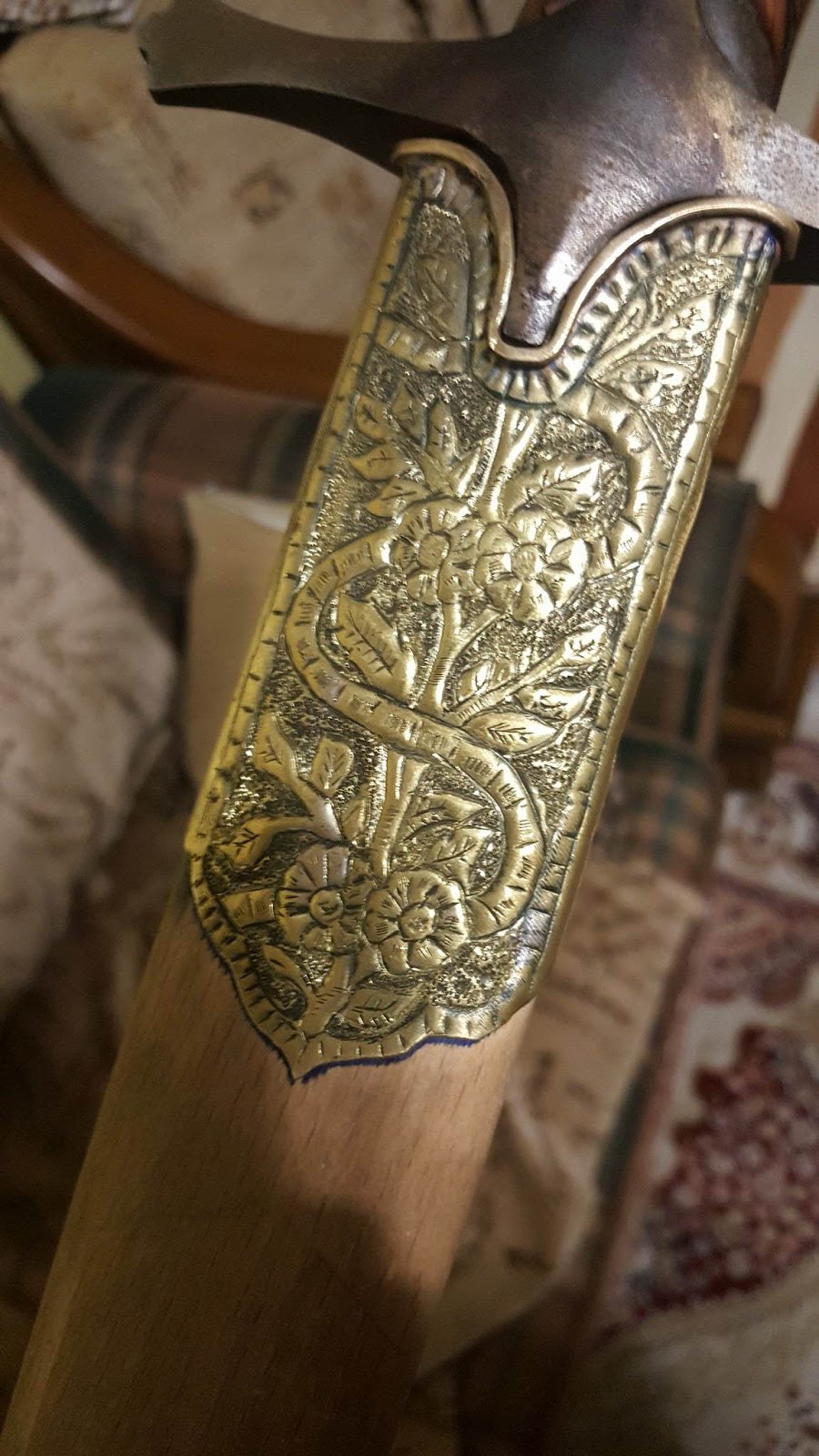
My second important sabre in my collection just finished recently. I already have a 16th cc replica, this time I wanted to have a later time, 17th-18th cc. It is of the Ottoman 'karabela' type. It was custom made by the famous swordsmith Osman Baskurt.

  • Weight 730 gr
  • Balance is at 17 cm from crossguard
  • Lenght 93 cm 
  • Width 3.4 at c.guard and 3.5 at spur (mahmuz)
  • Thickness of spine starts from 8 mm tapers to 6 mm at spur
  • 1070 steel
  • Steel folded to 324 layers


I was also very interested in the making of the sabre, so here is the swordsmith's comments and step by step pictures. This sabre is forged by an old technique similar to the japanese one. 1070 steel started from 12 layers and folded until 324 layers there are some patterns but they are not contrast of nickel or carbon but contrast of layer connection due same steel folded on each other and steel polished to mirror finish like in old times.

The Crossguard is made from mildsteel and hilt made out of cherry wood and given an antique look to it. Scabbard covered with brown sheep leather and repousse work has done and all the design on fittings taken from an original example


Saturday, 31 March 2018

The Turkish Horse

Summary: 'Recently a genetic study was published confirming that a lot of horse breeds around the world have Turkish horse DNA, especially the English Thoroughbred'

Dear friends, an old Polish saying goes like this:

Horse Turkish, 
servant Mazurish;            
Hat Magyarian, 
saber Hungarian.   

The English Thoroughbred (ETB) is the worlds fastest horse and maybe the most known. It is the horse breed that you see in the horse races and it is widespread throughout the world in horse riding clubs, polo/Polocrosse clubs, etc. It is maybe the first horse that comes to your mind if you think about horses. It is among the most valued as well with top foals sold at prices over 1 million USD.

English Thoroughbred horse (ETB)

There is a lot of discussion about the provenance though. It all starts with my ancestors, the Ottoman Turkish army loosing the battle of Buda (Hungary) in 1686. In this battle, European forces capture a Turkish Warhorse and bring it back to England, calling it the 'Byerley Turk' named after Lord Byerley who was in the possession of the horse. Recognising the qualities of the horse, they started a breeding program. Together with a second (Darley Arabian) and third (Godolphin Arabian) foundation Sire, these 3 horses were the basis for the English Thoroughbred. (It is to note that European horses were no match in battle against Turkish horses in terms of speed and stamina (see: The European destrier horse))

So far so good, the discussion is around which breed's genes were dominant as they are different breeds involved. It was widely accepted that the main ancestor of the ETB is the Arabian horse (also due to a strong Arabian horse lobby). 

You could say that there are some points against this view:
1. The original Arabian horse looks very different from the ETB. It is smaller (14-15 hands vs 16hands)
2. Dished face of Arabians in many lines vs the straight long face of the ETB
3. A different confirmation and muscle/body shape
4. The speed - The ETB is much faster than the Arabian horse.
4. Even the mentality of the horse differs, Arabs being more spooky and difficult to handle by nature
5. The speed and endurance were unseen in Europe before, so they bought further Turkish horses and used them in the breeding of the ETB:
  • Darcy White Turk
  • Edward Hale's bayTurk
  • Belgrade Turk mare
  • Helmsley Turk
  • Darcy Yellow Turk
  • Place's white Turk
  • Akaster Turk
  • Carlisle Turk

Unfortunately, today, the old Turkish breed is extinct in Turkey, but the closest relative lives on in Iran and Turkmenistan, the Akhal Teke. Just looking at the horse you will see that it resembles the ETB much more than the Arabian horse. These horses have top speeds similar to the ETB and are also amazing in long distance riding. This breed is a true war horse. For example, in 1935 a 2600 mile race from Ashgabat to Moscow was held with Akhal Tekes!

Gokmen
Akhal Teke horse

In contrast, here is an Arabian horse:
Arabian horse


Sunday, 18 February 2018

Ottoman Turkish War arrow replicas


I built Ottoman Turkish arrows in the past and with each time I learned new things. This is my passion for the last years.
Archery is the art of repetition. You are constantly trying to keep every factor the same with each shot - bow arm angle, pulling arm angle, draw length, anchor point, aiming point, release etc in order to increase accuracy. If everything is the same, then theoretically you will hit your target each time. In reality it is not so easy e.g. you can't guarantee aiming at the same spot, especially if you are shooting instinctive (without any aiming device, scope). One of these factors is the arrow. Your arrows need to be as uniform/standard as possible. If one weighs 3 gram more, is slightly shorter, is differently tapered, you will not hit the target with your next shot even if you aimed at the same spot or managed to keep all the other factors the same.

(Some past work:)
Ottoman war arrows with broad heads with sinew wrapping

Ottoman target arrows

Ottoman war arrows with armour piercing heads, sinew wrapped

Now I tried a new set of 20 Ottoman war arrows, again it is maybe better than my last sets but it is only an iteration to build the arrow masterpieces in the museums. I feel it is impossible to get close to the craftsmanship of the old arrow masters.

The first challenge I faced was the arrow length, which is correlated to the weight, which is the second challenge. Our ancestors in the 16th-17th cc were smaller than us, thus their arrows were shorter (typically 68-72cm total length). If you replicate a museum arrow 1:1, you will not be able to shoot it. Yet how will you make it bigger? and how heavy should it be?

First of all, the typical anchor point for Ottoman war archery is just below the chin, similar to today's olympic archery. With this anchor point, my draw length is 27.5 inch.

I found different arrow information in catalogues, books, online and collected the weight and length information in an excel table. Then I created a graph in which you can see the ratio length to weight. I included Ottoman and also Tatar war arrows. Slowly you could see clusters of typical arrow length and weight. I also included an average line each. (if you find any more arrow specs, let me know I will include it).


As my draw length is 27.5'', I reckoned with a total arrow length of 74cm (including arrow point and nock). For that length, I assumed the arrow weight will be around 27 gram according to the above graph.
The above is good reference. I see a lot of Turkish colleagues drawing until the ear (and breaking those Grozer Turkish bows). Drawing to the ear is rather Tatar archery and you need a Tatar bow which has a longer draw.

Second challenge is the tapering (called endam in Turkish). Turkish arrows are always tapered which makes the arrow more aerodynamic, thus increases speed. It is thinner at both ends and thicker in the middle. But how thin?

Below are measurements for a Turkish war arrow from a museum (blue). Thickness is measured in mm starting from the base of the shaft right after the arrow head. This way you can 'visualize' the taper. This original arrow was shorter than the arrow I wanted to make. So I tried to estimate values for a slightly longer arrow. The result is the red graph. You will see how far more superior the old masters are! If you pay close attention you will see that the blue graph resembles a cross section of an airplane wing. 


Anyway, my arrows are not as perfect as the old Turks' arrow but still they fly very well.
Some extra information:
  • The arrow points are handforged steel with hardened tips, 3.6 gram.
  • Added bone washers so the arrows survive the impact on armour
  • Total arrow length: 74cm
  • Total arrow weight: 26.5 gram


Gokmen Altinkulp


Feathers in preparation (without quill)

Shafts after painting

Arrow heads: hand forged armour piercing heads with bone washers


Saturday, 24 December 2016

Turkish Sabre: Kilic

I want to share the most recent addition to my collection, a 16th cc Turkish kilic based on a kilic in the military museum Istanbul. The swordsmith of this excellent piece of art is Kayahan Horoz (www.facebook.com/CEBEHANE)

I am researching the equipment of a16th century Turkish/Ottoman Knight (Sipahi), and no knight would be complete without a sword. The Turks had sabres, called kilic (kılıç). Together with the bow and arrows, the kilic was the primary weapon of the Sipahi.

A lot is being said about the famous Japanese Katana, yet I believe some other swords in the world are not less useful or beautiful. The kilic has been developed in the steppes of Central Asia over many centuries and had much opportunity to be fine-tuned and perfected in design due to constant use in battle.
Kilic and sheat (kilic and kin)
How it feels in the hand: compared to European swords of the time it is much lighter and the weight is more at the tip. It is very much suited to circling moves. Once it is moving it is very easy to go on and a lot of force can be created. Imagine you hold a 90cm rope with a stone attached to the end. Through quick circling moves, you can create a lot of energy. Same principle with the kilic, immense cutting power is unleashed with circling moves. Yet thrusts are also possible with a kilic, contrary to popular belief. Also, in the 16th cc the kilics are not as curved as the kilics from later centuries.
Sultan Suleyman the Magnificient's kilic (16th cc) Military Museum Istanbul in Harbiye
The swordsmith Kayahan Horoz had access to this kilic and could measure it in detail. The hilt is a later addition, probably 19th cc. 

This blade is a precise replica of Suleyman the Magnificient's kilic at the Military Museum in Istanbul. Overall this kilic is 94 centimeters and 723 grams. The blade is forged from 5160 steel and differentially heat treated to give 60 HRc on the edge with a soft spine. The handle and the scabbard are made of wood, covered with goat leather. The crossguard, pommel cap, and all the metal parts on the 325-gram scabbard are made of German silver, decorated with repoussé. What's so special about this blade is that if you look carefully you can even see a hamon.

Balcak(cross guard) and hilt (kabza)
 The hilt is based on a 16th cc kilic in the Royal Armouries Leeds.


Yalman (part with double edge). You see the fuller (groove) nicely here.
The kilic has more cutting area but is yet lighter due to its genius construction of the fuller (oluk). It has a 'mahmuz', a hammer-like weight at the start of the yalman, which makes this sabre a much better cutter. Imagine you cut cheese with a knife and help it by pushing the tip of the knife with your thumb - same principle. The best point on the blade to cut an object is therefore the area under the 'mahmuz'. The weight of the mahmuz and the curvature of the yalman enforce the cutting. In this way you can see in historic miniatures how someone can cut somebody vertically from the head right to the belly including a steel helmet. Note the sipahi at the bottom of the picture cutting through the armoured knight:
Battle of Mohács 1526, Ottoman miniature

Here are the names of the different parts of the Turkish Kilic:

Friday, 13 February 2015

Saladin's army

If the crusades are mentioned people think immediately of the eternal fight of the Arabs and Christians and of course Saladin. Presumably the present map of the Middle East with all the Arab states and of course Hollywood create this thinking.
What fosters this as well is that in all films about Saladin or the Crusades, Saladin and his army are portrayed like Arabs, with turbans, Arabic culture etc.

So was this really an eternal battle between Arabs and the West? Who did the crusaders have to fight? Who were the men in Saladin Ayyubi's armies?
Let's have a look at literature instead of movies.
Anne-Marie Edde has researched the biographies of 122 of the emirs of the time and has written an academic article: ''Kurds and Turks in the army of North Syria''. The first page is below:

I translate freely:
"The ethnic composition of the Ayyubid soldiers is much debated topic. For a long time people have thought the Ayyubid armies had a large number of Kurdes because of the origin of the dynasty. David Ayalon has shown especially starting from the Egyptian examples that the army of Saladin and the successor armies were in fact Turkish. Even more, he confirms that the Kurds made up only a limited power in the army and some were even discriminated under Saladin. So for D Ayalon there is a number of similarities and a continuity between the Ayyubid and Mamluk armies. I found it interesting to analyse the situation of the Ayyoubid army of North Syria which has always recognised the suzerainity of Cairo.[...]"
(David Ayalon was a renowned historian specializing in Middle Eastern dynasties especially the Mamluks)
Another source mentions that the majority of Saladin's army consisted of Turks (Carl F. Petry "The Cambridge History of Egypt" p. 226)

So not only is there no mention of Arabs, but the research shows that Saladin's army was a mixed Turkish / Kurdish army with the majority being of Turkish origin. So why is this important?
By knowing the ethnic composition of the army we will be able to have a better idea of their military equipment, weapons, their fighting style, what language they spoke and even how they looked like (which may surprise many).

The below picture gives us an idea of how the Turks looked like at that time. Some would say "Chinese" or Asian, which will be a big surprise to many to imagine Asian people fight against the crusaders. The Turks of the time spoke a Kipchak dialect of Turkish, the same language as the famous Golden Horde would have spoken. And it is written that Saladin spoke Turkish with his commanders (John France: "The Crusades and their Sources" p.84).
Varqa and Gulshah, 13. century Seljuk / Turkish
The Turks had a totally different fighting style than the Arabs. The latter relied traditionally on lances, straight swords and fought on camels. The Arabs preferred shock tactics with frontal lance attacks. The Turks were horse archers instead. Their main weapon was the Central Asian composite bow which they mastered formidably. They had light and fast sabres instead of a straight swords. They rode strong, tall, fast and enduring horses brought from Central Asia. The Asian Bactrian Camel was merely used to carry supplies. The special horses enabled them to use Central Asian style strategies like e.g. hit and run tactics, feigned retreat. The Turk's armour consisted of light but reliable lamellar armour. Instead of Arabian style clothing, the Turks preferred Asian, Kimono-style outfits. Instead of Arab/Bedouin style turbans, the Turks preferred Central Asian style hats e.g. felt hats called "Börk" or other hats called "Serpus" / "Tarbush".

The main force the Crusaders had to face were the Turkish horse archers. Based on historical accounts, they poured down arrows on the Crusaders for hours and days inflicting heavy casualties. When the Crusaders decided to confront the attackers with a cavalry attack, the Turks retreated with their faster horses, The Crusaders never caught them with their slower horses (only at the end of the 17th century will the West capture some Turkish war horses, breed them and "create" the fast English Thoroughbred horse and use the blood in the breeding of countless other breeds.) The pursuit lasted hours, sometimes days and at the end the retreating exhausted Crusader army was defeated easily. Alternatively the retreating Turkish army lured the pursuers into a trap with a larger Turkish army waiting e.g. behind a hill.

Seljuk bowl, 12.-13. century